onsdag den 13. juli 2022

Camilla - Fanny Burney (1796)


Camilla

It was with much anticipation I went into “Camilla”. Frances Burney’s first novel “Evelina” is to this date one of the best books I have read on this List and “Camilla”, being her third novel, had to be good. “Camilla” is not a bad novel, but it is in my opinion an inferior novel to “Evelina”, partly due to some plot flaws and partly because it has not aged as well. Where “Evelina” pointed forward, it feels as if “Camilla” is pointing backwards.

In “Camilla” we follow the Tyrold family, the timid and meek Lavinia, the emotional Camilla and the scholarly but deformed Eugenia. They have grown up in the virtuous and protected home of Pastor Tyrold and Mrs. Tyrold. Mr. Tyrold is the younger brother of the country Squire Sir Hugh Tyrold, a generous and not too clever older man without children himself. His nieces spend a lot of time at his place, Cleves, together with Sir Tyrold’s other niece Indiana Lynmere, a very pretty, but vain and vacant girl.

During the period of what appears to be one summer the girls are exposed to the surrounding world and the dangers lurking everywhere. There are two main plotlines. One is of Camilla and her on/off relationship with Edgar Mandlebert, the other is the terrible adventures of Eugenia.

Camilla and Edgar are in love with each other, but instead of being candid about it, they manage to misunderstand each other to an exceptional degree. This is largely driven by Edgar’s wish to get proofs that 1. Camilla actually loves him (which is sort of understandable) and 2. That she will be a good wife. As Edgar is a very old school prude and puritan, this means that Camilla should not see the wrong people or do any wrong and certainly not be improper in any way at all. Since being exposed to world means that Camilla will get in contact with all those things, especially as she is untutored and have grown up in ignorance, Edgar, always lurking in the background sees plenty of things that convinces him that Camilla is not up to his standards.

Eugenia is subjected to blow after blow. At first it was Sir Tyrold’s plan to marry her to his nephew Clermont (incestuously?!) who were on the Continent studying. For this purpose, Eugenia received scholarly training for which she has a great talent. Clermont, when he returns, turns out to be a jackass and a moron and certainly not interested in Eugenia. Then Eugenia meets the equally scholarly Melmond, but he sees only Indiana’s beauty and finally she is the prey of mercenary and brutal fraud Alphonso Bellamy.

“Camilla” is a long book, over 900 pages, but we get the outline of these plots rather early and the bulk part of the volume is mainly Camilla and Eugenia sinking deeper and deeper into trouble. Their trouble of the heart is supplemented and, in my opinion, overtaken by pecuniary trouble. None of the younger generation in the Tyrold household has any sense of economy, especially the brother Lionel and Clermont, who between them manage to throw away thousands of pounds, threatening to ruin both Tyrold households. When Camilla through little fault of her own is preyed on to lose a much smaller amount, she sees herself as the ruin of the family.

Burney is very good with characters. Every character is distinct with their own idiosyncrasies. Sometimes bordering caricature, but they are all alive and real people. Burney also has a very good sense of the environment into which the characters move. You get a feeling she was not only an observer but actually was there in these settings, in the Rooms in Tunbridge or the bathhouses in Southampton. This is not an imagined world as much as a real world with imagined characters. She is also good at setting up the drama. The trouble Camilla and Eugenia get into is very real trouble, especially the pecuniary trouble and the hole they find themselves in is very deep indeed.

Unfortunately, as mentioned above, there are a number of problems here. One has to do with plot resolution. With about 50 pages to go I got the feeling Burney herself got confused how to resolve this. There are some very real problems here, both for Camilla and for Eugenia, but instead of working towards a resolution we spend the majority of the end-section with Camilla fretting, crying and gushing without anything really coming out of it, while around her, things sort themselves out on their own. Just like that. Even Eugenia, the most capable of the girls, just resigns and have outside agents, through accidents, sort things out. Why did nobody call out Mrs. Mittens?

Another problem has to do with the characters and their sentiments. Camilla always means well, but is either mislead by principles and good heart or is simply too unprepared for the outside world and consistently makes the wrong choices. And Edgar… if ever I saw a “hero” who did not deserve to be one. Very early I decided very much against him. To paint him and his sentiments in a positive light was so at odds with my own opinion. I was wondering why on Earth Camilla was pining for him at all. Somebody needed to kick him badly, and when he comes around in the end, it is not with an excuse for his opinions or actions, but because he is now convinced she is good enough. Phew.

My two favorite characters were by far Mrs. Arlbery and Sir Sedley Clarendel. Both represent modern ideals, free people who are capable of doing what they want, not caring of the opinion of prudes, but smart enough to make the right choices. And both of them with a heart. I get the feeling Burney actually admired this type, but was afraid to make them the ideal of the story. Their sentiments were completely at odds with those of the Tyrolds’ and particularly Edgar, representing as they were the modern world. Mrs. Arlbery also called out Edgar early on and warned Camilla what kind of marriage she was aiming for with him. When Sir Sedley takes an interest in her she gets the chance of setting herself free, but decides not to. That is her choice of course, but it also marks this as a poorly aged novel.

I did enjoy reading “Camilla”, Frances Burney is too good a writer not to, but it was at times an infuriating read and not up there with “Evelina”.


torsdag den 12. maj 2022

The Monk - Matthew G. Lewis (1796)


The Monk

There seemed to have been a wave of dark or gothic literature around the end of the eighteenth century and likely into the beginning of the nineteenth century, ranging from the romantic to the macabre and outright disgusting stuff. Whether this was inspired by the horrors of the French revolution or some other underlying and earlier reason I do not know, but the book List editors certainly have an affinity for these stories.

Matthew Lewis’ “The Monk” is, as I understand it, a highly influential work that tapped into this stream. From the basic idea that power and righteousness corrupt, he wrote the twin stories of two girls who falls into the clutches of corrupt monastic rulers. Or, as considered from the other side of the table, of the fall from grace of people who were supposed to be above these things, corrupted by power and temptation.

One story is about Raymond, Agnes and the prioress of the convent of St. Clare. We meet them while she is a nun and he is attempting some covert communication with her. In flashback we get the story how he was travelling in Germany incognito (he is the son of a Marquis in Spain) where he meets and fall in love with Agnes, a guest at the castle Lindenburg. Unfortunately, the baroness of the castle, Agnes’ aunt, is deeply jealous, thinking she should get his attentions. Raymond is kicked out and Agnes comes up with a scheme to pretend to be a renowned ghost to escape with Raymond. The real ghost gets in the way, Raymond disappears and Agnes, believing him dead, joins a convent. Back in Madrid, when they are reunited, they start a clandestine affair, Agnes gets pregnant and the prioress, massively incensed by this violation of rules, confines her to die in the dungeons of the convent.

The second story concerns Antonia, Lorenzo and the abbot of the Capuchin monastery, Ambrosio. In this story Lorenzo, a nobleman, is infatuated by the pretty but demure Antonia. Antonia’s father was of nobility (and related to Raymond) but disowned by his family and Antonia’s mother is convinced that so uneven a match will not end well. At the monastery Ambrosia is a super righteous monk who is slowly being led into temptation. A young novice he cares a lot about, Rosario, turns out to be a woman, Matilda, and she becomes the instrument to gradually corrupt the Monk. They start an illicit affair, but eventually he tires from it and instead turns his attention on the pretty Antonia. Matilda seems more interested in turning the monk onto the dark path than having an actual relationship and it becomes increasingly clear she has access to dark powers. With these Ambrosia manages to get Antonia into his clutches, hiding her away in the dungeon. Will Lorenzo get to her and his sister Agnes in time?

Lewis was very young when he wrote “The Monk” and I could tell how it is driven by his urge to tell a story. It is quickly paced and covers a lot of ground in relatively few pages, but it is also rambling in the sense that Lewis cannot decide exactly what story he wants to focus on and from what perspective and this gives it an almost anthology quality. There is a very important part about Ambrosia’s decent from holier than thou to be entirely in the thrall of sexual desires, ready to sacrifice every principle to satiate it. Antonia’s story is of course linked to it because she is his victim, but Lorenzo, the hero of the story, is largely relegated to an impotent observer and much less interesting to Lewis. The story of Agnes, Raymond and the prioress is, although the characters and linked to the first story, almost tangential to it with very little connection. It is a detour, an interesting one, but also so massive and different that it removes the focus from Ambrosia. I think Lewis let himself get carried away and he struggled to tie the stories together.

Thematically this is an attack on the hypocrisy of the righteous. That the vanity of religion corrupts and that we are not to trust those. It does feel a bit thin, though, and the real driver seems to me to be a desire to write a luscious and macabre story with ghosts, sorcery, pretty girls and evil people of power.

Reading up on the story before going in, I had the impression it would be way darker, maybe down the road of de Sade, but in that sense, I was happily disappointed. Sure, there is both rape and murder, but much less of it than I was led to expect, and it is not dwelling on it with sadistic glee.

The final verdict is that it is an easier and more entertaining book to read than expected but also a story strangely out of focus and unpolished. It was a bit hit in its time, but I frankly cannot see why people got so worked up on it.


onsdag den 13. april 2022

Wilhelm Meister’s Apprenticeship - Johann Wolfgang von Goethe (1795)


Wilhelm Meister's Apprenticeship

Can you be impressed and confused about a book at the same time? I hope so, because this is exactly how I feel having just read Goethe’s “Wilhelm Meister’s Apprenticeship”.

In this we follow a young man called Wilhelm Meister of middle-class origin. Wilhelm Meister is in love with theater. Watching it, the production, the plays, the characters and not least the actors and especially the actresses. He is chaffing at the expectations that he will pursue a career in the family business and easy to distract with anything theater.

On a business trip he gets seriously sidetracked and involved with actors and actresses and as they see him as a source of funding, he is soon involved in a theater project. Wilhelm’s ideal about theater and the reality of the business are quite different sizes and while he is not exactly being abused, he is being led on and for awhile I saw some comparison to “Der Blaue Engel”. But Wilhelm Mester is a lot more reflective than Professor Rath, taking a lot of responsibility on his shoulders and genuinely care for his, mostly ungrateful, colleagues.

Yet, Wilhelm is powerless to actually take charge of his life. Whenever he tries, it becomes false starts and instead he just drifts along from a conviction that fate is taking him to the right place. The result is that other agents are constantly pushing him around and he is lord of nothing.

There is a break in the story and when it returns, the tone is different. It turns out that practically everybody in Wilhelm’s surroundings is connected, that he is being manipulated in a way to discover for himself his true self by something called the Tower Society. Exactly why they take this interest in him and what their target is, is entirely unclear to me. The result, however, leaves Wilhelm as powerless as ever to control his own life.

Johann Wolfgang von Goethe wrote the first part in the 1770’ies, then only resumed the manuscript 20 years later and that shows. Where the first five chapters feel like a burlesque on the emerging theater scene in Germany with Wilhelm as the blundering fool but also as our keen observer, the last part is entirely different. Suddenly all the strings are being tied up. Apparently insignificant characters get a purpose and there is a mysticism and presentation of ideas entirely absent in the earlier part. Clearly Goethe has something on his mind and got some ideas about education, religion and purpose in life. But who makes that purpose? Are we born with it? Guided to it by “helpful” people or are we free to set a course on our own? Is Wilhelm Meister better off drifting along, making decisions on the spur of the moment? Or does he get to a better place if he is guided? And who reserve the right to guide us?

I sense a far more reflective Goethe in this latter section, one who is influenced by the enlightenment and the revolutionary thoughts in France. This is an age where fixed patterns are breaking up and people are allowed to reconsider their place in the world, especially the bourgeois. But what is to replace that earlier structure?

Meanwhile, Goethe himself had a love affair with the theater and was deeply involved with the theater at Weimar (where he wrote his most famous work “Faust”), so I definitely sense an autobiographical streak here as well. Is Goethe ironizing over his own life?

Ultimately, I am not certain what exactly Goethe is aiming toward with this novel, and I wonder if he was himself certain. Maybe he was just bouncing ideas and Wilhelm Meister was the unwilling victim of those ideas.

Absolutely recommended. Among the best books on the list so far.


torsdag den 17. marts 2022

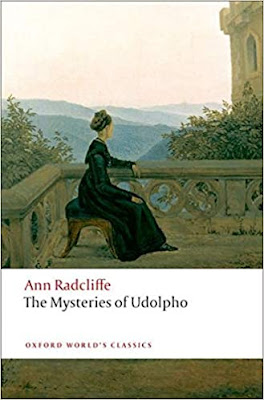
The Mysteries of Udolpho - Ann Radcliffe (1794)


The Mysteries of Udolpho

Ann Radcliffe’s “The Mysteries of Udolpho” is touted as THE gothic novel to read, containing ghosts and old castles and mysterious murders. Sounds juicy and true enough, the story has all these elements, but not in that undiluted form we are used to expect in our time.

For the first third of this tome of a book (my version counted 672 pages), this resembled a romantic novella from a Readers Digest. Wholesome romantic fantasies in beautiful settings. Okay, there are parents that die, but even that is very pretty. A voyage through the mountains is mainly a highly detailed and sentimental description of the scenery and how it resonates the feelings of the characters.

We hear of Emily, a young French woman of the lower nobility and how she makes a journey from Gascony to Languedoc to improve the health of her father. On the way they befriend the young chevalier, Valancourt and a romance blossom. Emily’s father does not get better, but dies near the haunted castle of Chateau le-Blanc. Left on her own Emily falls under the guardianship of her aunt, Madame Cheron. She is not exactly a pleasant woman and when she marries the mysterious Montoni, Emily must go with them to Italy, far away from her Valancourt.

In Italy she becomes the de-facto prisoner of Montoni in a dilapidated castle, Udolpho, in the Apennines and this is where the novel turns gothic. Montoni is a mobster and an opportunist who seeks to achieve wealth and power through dominance and underhanded villainy. Emily’s part in his schemes is to be married away for his personal winning, a fate Emily consider too horrible to contemplate. Emily also fears for her life, but mostly for her virginity and then there are the ghosts in the castle…

“The Mysteries of Udolpho” is apparently often being considers a flawed, maybe even laughable novel. Radcliffe is good at building up tension, when she finally gets to that point, but her resolutions are terrible. There are several convoluted mysteries in the story. Supernatural, criminal or otherwise. They tend to scare or confuse Emily or her impressionable maid, Annette, but they almost uniformly deflate when they get resolved. Sometime revealed in an off-hand way, there is always a prosaic, even boring, explanation and Emily usually get out of her trouble surprisingly easy and with little or no effort. Her major quality being her ability to faint from fear and to be modest when tempted.

It is also obvious this is a story from Radcliffe’s fantasy. It is deeply anachronistic, the geography is all wrong and the men and women are cliché characters from a teenage girl’s day-dream. It is often difficult not to roll the eyes and groan. Yet, in the build-up phase there are these moments of brilliance that makes it worthwhile to read this book. The riddles are really quite impressive. So much more disappointing is it when they deflate in the resolution.

I am probably of the wrong gender for this novel, and I certainly belong to the wrong century. It is very possible a female reader two hundred years ago would find this a masterpiece and I could also see this be made into a telenovela. For me though it is merely okay and certainly way too long.


søndag den 16. januar 2022

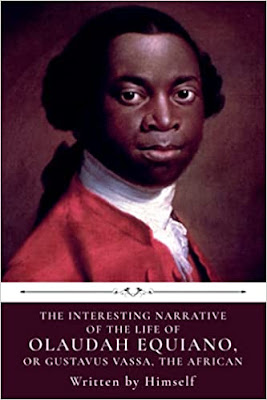
The Interesting Narrative of the Life of Olaudah Equiano - Olaudah Equiano (1794)


The Interesting Narrative of the Life of Olaudah Equiano

Some of the most interesting books on the List are the autobiographies. I previously read the amazing story of Bernal Diaz del Castillo and several the books have been pretended autobiographies (fiction in first person narration) and that of Olaudah Equiano (with the most absurd long title of “The Interesting Narrative of the Life of Olaudah Equiano or Gustavus Vassa, the African”) follows in those footsteps. His life was an odyssey worthy of a tale.

Equiano was a native West African, who at a tender age was kidnapped from his village and sold to slavers. Arriving in the West Indies he is “lucky” to be sold to a “good” captain of a ship who uses him as part of his crew. In that function Equiano takes part in the Seven-year war against France as a young boy. This is not without physical danger as Equiano is close to getting shot and bombarded to pieces. During his travels Equiano visits England and gets familiar with family and friends of the captain and he starts learning to read and do math. At the end of the war, when he expects to be set free and get a share of the prize money, his captain pulls a trick on him and sells him as a slave to a ship going back to the West Indies. Turns out the captain got a new wife, and she wants him to get rid of Equiano because he had become a favorite with his former wife.

Again, however, Equiano is “lucky” and gets sold to a merchant who is decent to his slaves and uses him and his slaves to work in his shipping business. In that way Equiano gets to sail all over the Caribbean and see and experience firsthand how slaves and black people in general are treated. Ultimately, Equiano is able to buy his freedom, but even as a free man there are no justice for black people and he narrowly escapes many dangers, both from white supremacists and from the natural dangers of a seafaring life.

The general message and ultimately the purpose of the book is to be an eyewitness to the injustice and inhumanity of the slave business and how wrong it is that there is no justice whatsoever when it comes to colored people. Equiano formulates himself in a way a British gentleman or lady would be familiar with in the eighteenth century and acts according to what is considered common sense and gentile behavior, effectively removing the “them and us” barrier. Equiano is on the inside, telling the reader he is no different from her or him, so why does he need to be treated any different? That he turns (intensely!) pious towards the end even serves to remove religious arguments (heathens are lesser humans).

As such it is incredibly effective, even for a modern reader. You cannot read this and not feel indignation and shame of belonging to a nation that dabbled in slavery (yup, some of the rich eighteenth century mansions in Copenhagen were built on slavery wealth). It is easy for us today to condemn slavery as an inherent evil, but it took more back then. It is convenient to shut the eyes on the darker consequences of what brings you wealth, that has not changed in 230 years. The book was therefore also a highly political text in support of the abolitionist cause and given political agenda’s ability to color things favorably it is possible that not everything in this text holds water. Some criticism has been raised that Equaino was in fact from South Carolina and not West African, but it actually matters little. Even if some of the events are imagined, they are painted so vividly and true to a reality in the West Indies that the message rings true.  

Even without the political angle, this is one spectacular odyssey and the sheer adventure of it was enough to keep me riveted throughout.

Only miss for me is the religious emphasis in the last three chapters. They are mostly filler and I could have done without them.

Nevertheless, strongly recommended, both as an interesting adventure and for anybody interested in slavery and race issues. There were times reading this I wondered if we really have come that far in 200 years.


fredag den 31. december 2021

Happy New Year 2022


Happy New Year 2022

Again, we are here, on the last day of the year and again we are saying goodbye to a year that will not be missed. Just as we thought the pandemic was over, heck we even discarded use of masks altogether, it is coming back big time and Denmark is now officially the most infected country in Europe (with a large margin!) and possibly the world. Well, that is just this year in a nutshell.

We started doing online training at the office and that has become so popular that I have done little else since summer. Nobody is going anywhere anymore. For a guy like me who used to travel 7-10 times per year, this is a big change and very sad too.

Having said that, I am grateful that I have lost no one in the family and those who got the virus, got through it easy enough or at least survived. I do hope we are soon through this.

As usual on this day I take stock on what happened on my blogs in the past year and, well, that is mostly business as usual.

I did a total of 59 movie reviews in 2021, which is the same as I did last year. Clearly this is my level of pacing. Of these 49 were List movies and 10 were off-List. This took me from 1972 to 1975. The most interesting event for me being the discovery of the Cinemateket in Copenhagen, which appears to have anything ever released in Denmark. Not the last time I will use that. In case anyone of the staff read this, thank you for kind assistance.  Otherwise, I will not point out anything special from this period except that I am listening to an awful lot of groovy seventies music these days.

On my book blog I have reviewed 11 books in 2021 which is great considering my target is a mere 5 books per year. This has taken me from The Sorrows of Young Werther (1774) to Caleb Williams (1794), which is a neat span of years. The most remarkable thing is how international the List has become with two German books, five French, one Chinese and three British books. I like that the List editors has made this a list of world literature and not just English language books.

I wish all my readers a happy and healthy new year and may the new year bring better times to all.

And remember, as legendary Danish movie critic Ole Michelsen used to say on sign-out: “ Movies should be watched in the cinema”. Cannot wait for them to open again…


torsdag den 30. december 2021

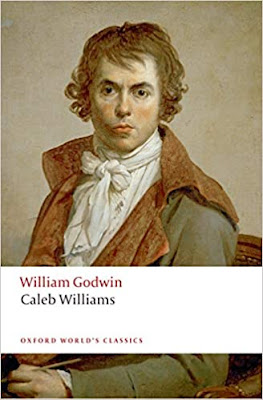
Caleb Williams - William Godwin (1794)


Caleb Williams

With “Caleb Williams”, or Things as They Are; or, The Adventures of Caleb Williams” I am back to British novels. The author is probably more know as the husband of early feminist Mary Wollstonecraft and father of Mary Shelley (Frankenstein), but “Caleb Williams” is sufficiently interesting to stand on its own.

The story is a first-person narrative of a young man, Caleb Williams, who is hired as secretary for Mr. Falkland, a country squire. The first volume tells the background story of Mr. Falkland, how he is a man on noble mind and intention, but fell into a depression after an affair with neighboring squire Mr. Tyrrel. This Tyrrel was a brutal fellow who was deeply envious of Falkland and tormented those who opposed him, such as his niece and a tenant, called Hawkins. After a fight with Falkland, Tyrrel is found dead, and Hawkins is blamed.

In the second volume, Williams cannot control his curiosity but is digging into this mysterious death. Despite several warnings to mind his own business, he finally learns, and Falkland admits, that it was he who murdered Tyrrel and let Hawkins take the rap. As a price for learning the truth, Williams must stay with Williams forever under close guard. Something Williams quickly gets fed up with.

When Caleb Williams insists on leaving, Falkland fabricates charges against him to send him to prison and possibly the gallows. Willams escapes and throughout the third volume we have a cat and mouse game with Williams constantly being pursued by Williams.

The immediate story serves as a thriller. It is tension on high level to follow first Williams playing with fire and then trying to evade his pursuers. Especially the last third reminded me a lot of the movie “The Fugitive”. Those that are pursuing Williams care nothing for his innocence, there is a price on his head and that is all that matters. He is setup by somebody to cover their crime, and as in “The Fugitive”, Willams only finds release when he stops fleeing and faces the real culprit.

Underneath, this is an undisguised criticism of the British legal system at the time and here it is important to keep in mind that the book follows on the heels of the French revolution, with new ideas about the order of society. Godwin’s criticisms are many, but notably the inequality before the law of those of rank compared to the servant class. Mr. Falkland can only be judged by his peers, and he is considered innocent on reputation alone. For a servant to even charge a nobleman with a crime is a felony in its own right, never mind his guilt. In this system, those without rank have no protection from the law. Secondly, Godwin is objecting to the conditions prisoners are subjected to. Life in prison is unspeakably horrible and prisoners are subjected to it without being convicted, but simply for being a suspect.

This is a commendable mission, and one that feels very much in order. I do not get the impression Godwin is exaggerating his examples, he had plenty of friends who felt the vengeance of the legal system. It is difficult not to feel indignation, but it is all plausible, although Caleb Williams is a tad more resourceful than most.

What I did not get was the ending. I read it explained that Godwin had a theory that the system could be reformed, not through revolution, but through understanding and honesty, by people simply talking to each other. Sounds commendable, but also, well, a bit naïve. Godwin is setting up that Willams should face Falkland, but rather than turn the table, they can simply talk it over and then get along. This despite Falkland being represented as a domineering and adamant opponent to Williams, almost a madman in his pursuit of Williams. I don’t know if I buy that.

Until that point though, this was a book I enjoyed reading more than I expected. It is lengthy at times, but especially the last third has a lot of drive, enough to keep me on the edge.

A moderate recommendation from me.