søndag den 11. juni 2023

Rob Roy - Sir Walter Scott (1817)


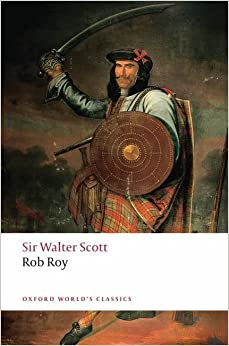
Rob Roy

Before Sir Walter Scott wrote “Ivanhoe”, he had a hit with “Rob Roy”. While I am quite familiar with the former, this is the first time I encountered the latter.

In “Rob Roy” we follow Francis Osbaldistone, a young man who protests against training as a merchant in his father’s thriving business. Francis has romantic dreams and counting pennies has no place in those. Mr. Osbaldistone is not to be trifled with, so he disinherits his son and sends him up to his brother, Sir Hildebrand Osbaldistone, on the Scottish border, who in return is invited to return one of his sons to take over the inheritance.

At Osbaldistone Hall, Francis falls in love with Diane Vernon and learns that the whole bunch there are Catholic Jacobites. He also learns that the sons of the house are all imbeciles except for Rashleigh, the one sent south, who is a cunning, self-serving intrigant. Oh, and he meets a mysterious Scotsman, Mr. Campbell.

Soon enough Francis learns that Rashleigh has driven Mr. Osbaldistone’s business to the brink of ruin and has escaped with the only papers that may save the company. Diane instructs Francis to find the solution is Scotland and so he ventures there with a Sancho-like Scottish gardener, Andrew Fairservice in tow. Thus begins Francis’ Scottish adventure that takes him across the Highland line where the lord and master is Rob Roy aka. the mysterious Mr. Campbell.

“Rob Roy” is an adventure story in the form of an odyssey. It is a journey that takes Francis Osbaldistone to distant regions where people and customs are as strange and wild as the landscape. There is a romantic element, especially concerning Diane Vernon, one of the very few women in the story, but also in regard to Rob Roy himself. He is presented as a Robin Hood-like character, a gentleman thief in a rough outfit, a noble savage, who is fighting a noble but hopeless cause to protect the outlawed McGregor clan.

There is also an underlying narrative involving a Jacobite rebellion, not the famous one in 1763, but a just as ill fought uprising in 1717. According to Scott’s story, the Osbaldistones and Rob Roy had a hand in that.

Curiously, our hero, Francis Osbaldistone, is not very much involved in what is going on. He just happens to be there when it happens, observing but taking very little action. It is always someone else who is doing, fighting, taking action, so as a hero, he is rather impotent. Even in his most personal affair, involving Diane Vernon, he is unable to interfere with her destiny that will take her away from him.

Rob Roy, on the other hand, is a man of action, sense and courage, the image of everything Francis admires but fails to be. Next to Francis though, he is just a side character.

This kind of adventure has a natural appeal to the boy in me and I really wanted to like it. It is not bad, but it is not an outright winner for me. I found it difficult to follow the narrative. Of course, it involves mysteries that should remain mysteries until the reveal, but even then, I do not understand all that was supposed to happen, or rather, why these things led to what happened. For people around Francis, I sort of understand the story, except that I cannot entirely connect the McGregors and the Jacobite cause, but why Francis needed to be involved everywhere baffles me. It also does not help that Scott makes the Scottish dialects become visible and almost audible by using phonetic spelling. Sure, there is a glossary at the end of the book, but I soon tired of going there all the time and just accepted that I missed a lot of the meaning every time they spoke.

I can understand why it is “Ivanhoe” and not “Rob Roy” that has survived in the public consciousness. Where the themes of “Ivanhoe” are timeless, “Rob Roy” is far more rooted in its time. The Jacobites are long forgotten, if even known outside Britain, and the transition of Scotland from its wild past to being an industrial and mercantile powerhouse was very much in process when Scott wrote the book, but is now a thing of the past (unless lawlessness is still thriving on some outlying islands…). Today, “Rob Roy” works as an adventure, an exciting tale of travelling into the unknown to meet people and dangers unimaginable. I just wish it worked better at that.

Not to be confused with the movie of the same name from 1995…


onsdag den 19. april 2023

Mansfield Park - Jane Austen (1814)


Mansfield Park

“Mansfield Park” is the fourth and last of this round of Jane Austen novels. It is also the most tricky one to get a grip on.

The setting of Mansfield Park is the manor of same name. Sir Thomas Bertram has two sons, Tom and Edmund, and two daughters, Maria and Julia with his wife Lady Bertram. Lady Bertram has two sisters, Mrs. Norris and Mrs. Price. All three have their flaws: Lady Bertram is indolent and uninterested, Norris is… a terrible person and Price fell in love with a seaman and lives in quasi-poverty with a horde of children. The oldest of these, Fanny, arrives at Mansfield Park at the age of 10 to be raised by the Bertrams and she is our heroine.

It is important to Aunt Norris that Fanny understands that she is inferior and that the Bertrams must always come first. She must also show gratitude, especially to Norris, for everything the Bertrams are giving her. As a result, Fanny, already a timid girl, remains a very humble and shy girl, more interested in the well-being of those around her than herself. When things start to unravel at Mansfield park, instigated by the two visitors from the city, Mary and Henry Crawford, siblings, Fanny finds herself in the center of a whirlwind challenging her moral compass.

“Mansfield Park” is very much a moralistic tale. Fanny represents good and moral behavior and the Crawfords, coming as they are from the city of vice, London, represent the challenge to moral behavior. With them as catalysts, the Bertram children are losing restraint and drift into vice. Even Edmund, the most “proper” of the four, falls in love with Mary and is tempted to participate in events he knows are wrong.

The challenge for the reader is to recognize right from wrong, something that is not made easier by two hundred years of moral evolution. When the Bertrams and the Crawfords want to set up a theater at Mansfield, this is considered highly improper, especially as the play is “Lover’s Vows”, a slightly daring piece. It is difficult to see how this should be the road to Hell, but there you have it. When Henry Crawford openly flirts with both Julia and Maria, it is easier to see this as problematic, especially since Maria is engaged to Mr. Rushworth, and his indifferent abandonment of both shows him as unreliable to boot.

For Fanny the challenge reaches its peak when Henry insists on courting herself and everybody pressure her into accepting his proposal. Only Fanny is not convinced and insists on refusing him.

I am torn on “Mansfield Park”. Fanny is often blamed as being the most boring and colorless of Austen’s heroines, but I do sympathize with her. A lot of her sentiments are things I can recognize in myself, her fears and her hopes and her finding refuge in a rich internal life. However, Fanny is a saint and I am not so there are limits, but I do feel I understand her. Similarly, I recognize the type of Mrs. Norris. Although she is intended as a caricature, I can see real people with many of her qualities and I understand how absolutely obnoxious they can be.

Where the chain jumps off is on two accounts. The distinction of what is proper and what is improper is exceptionally prudish. By any standards, the proper life, according to Mansfield Park is a very dull life. Anything resembling normal, youthful behavior is frowned upon and we are to think that a retired life of boredom is bliss. Austen simply goes too far here.

My other problem is that for all Austen’s insistence of doing the right and proper thing, apparently it is okay for cousins to fall in love and marry. The idea makes me gag, and it breaks some huge taboos of mine, but Austen seems to find no problem at all with that. Well, wait till she sees what sort of children this will produce…

The net result is a book I am not certain how to rate. There is so much quality Austen stuff here that it cannot be ignored, but also so much prudish moralizing that is difficult to accept. Reading felt like a curve, I loved getting into it, it was better than expected, but as it unfolds it gets increasingly difficult to take in. I am hesitant to endorse it, but how can you not recommend an Austen novel?


lørdag den 18. marts 2023

Emma - Jane Austen (1816)


Emma

The third Jane Austen novel in this marathon of mine is “Emma” (never mind I accidentally switched the order of this and Mansfield Park) and while there is a lot of familiar Austen here, it does feel like a departure from the previous two novels.

First off, the heroine of the novel is as usual a young woman, but not the lower genteel, almost impoverished girl I am used to from Austen. Neither is she the cynical observer to portrait gentility from the outside, the Austen alter ego. Instead, Emma is all that Austen is usually skeptical about:  Rich, unfocused, arrogant and busy running other people’s life. The only concession Austen gives Emma Woodhouse is that she is intelligent and at heart a good person. Austen famously mentioned that she had created a heroine that nobody would like.

Young Emma lives with the hypochondriac, but friendly, father at the Hartfield Estate in the fictional village of Highbury, south-east of London. This is a local community with a limited amount of people qualifying to be of interest to Emma. Regular farmers and tradesmen are simply below her interest. What she is interested in is matchmaking. She takes credit for the marriage of her former governess and friend with Mr. Weston and she spends a good third of the book trying to setup her friend Harriet with the vicar, Mr. Elton, rather than, God forbid, the successful, but not genteel, farmer, Robert Martin. It is no spoiler to say that this blows up spectacularly in Emma’s face, which indeed most of her schemes do.

When first the quiet Jane Fairfax arrives in the village to stay with her aunt and shortly after the dashing Frank Weston Churchill to visit his father (Mr. Weston from an earlier marriage), Emma gets more fuel for her imagination. Only the old family friend, George Knightly seems able to rein Emma in.

There is a development of several characters in “Emma”, as there usually is in Austen’s novels, and good for that. The Emma of the opening of the story is really not that sympathetic. Far too conceited and busy arranging the lives of others. We all know the type who is trying to arrange your life, convinced they know better, and I frankly have very little patience for that sort. Maybe a gender thing. Emma, however, grows out of it. Not through an epiphany, but as a process, partly guided by the disasters her interfering causes and partly by the horrendous example of Mrs. Elton, when she is introduced. She possesses all the poor qualities of Emma, but a notch or two worse. For me, reading the novel, I believe the development of Emma into a more understanding and respectful character was what I took most pleasure in. Austen has a wonderful way of making the process natural and believable and the Emma of the end is truly likable.

Austen is also as usual an expert on drawing very distinct characters. Almost, but not quite caricatures. Sometimes amusing, sometimes to serve a point, but always types we recognize. The host of characters in Emma are very much alive and real to the reader and not two characters blend together. If there is a miss here, then it is the strong focus on a particular strata of people, while those below, especially the domestic, are largely ignored. Part of that may be due to Emma’s viewpoint, but it is common for all the Austen books I have read.

If there is a weakness to “Emma” then it is the lack of a progressive narrative. Both “Sense and Sensibility” and “Pride and Prejudice” had a story that went from A to B, but although “Emma” also ends in a wedding orgy, it feels through the most part as if it is not getting anywhere. Part of that can be explained by the storyline being the character development, but this happens so slowly that you only really notice it in the end (or I did). I lacked something to drive the story and that made it a slower read for me than the previous novels. Or maybe it is just that active matchmaking is does not serve as an interesting plot for me. A gender thing again, perhaps.

Still, it was a lovely read and I am actually sorry that I am now done with the life of Emma Woodhouse. It would have been interesting to follow her further adventures. Highly recommended.


lørdag den 11. februar 2023

Pride and Prejudice - Jane Austen (1813)


Pride and Prejudice

This is supposed to be a re-read, I am positive I read “Pride and Prejudice” some 20 years ago, but except for recalling the names of the main protagonists, it turned out that I remembered absolutely nothing from first time round. So, this felt as a first read. I am a bit disappointed with myself, “Pride and Prejudice” is a good enough book to be recalled even that many years later.

In many ways “Pride and Prejudice” resembles the earlier “Sense and Sensibility”, but given that we are dealing with the same period, women from the same station in life and protagonists with similar traits, that is likely to be expected. Certainly, I can pour very similar praise onto the books.

Elizabeth Bennet is one of five sisters being raised by a very liberal gentleman father and a silly, emptyheaded mother from a lower station. Stations in life is super important in Austen’s worlds and the Bennet family is well enough off that they live in a manor with butler and maids, but not considered wealthy or important as such. Elizabeth is a smart and perceptive woman and her main difference from Elinor is that she is frank and independent minded. Traits that also sets her apart from women in general in this book.

The story revolves around her relations with a gentleman (from a higher station) called Mr. Darcy. When they meet early on, Darcy’s friend Mr. Bingley starts a relationship with Elizabeth’s sister Jane, Darcy feels superior to Elizabeth family and refuse any interaction (pride), and Elizabeth in her place forms an image of Darcy as a haughty and very unlikable character (prejudice). Although we as readers sense already in the early pages of the book that there is a similarity of mind between these two characters, in their heads they could not be farther from each other.

The development of the story is how these two sentiments are gradually broken down in a process where both of them learns to check themselves and get a better perspective on the both themselves and the world around them. The immediate agency may be a partiality, to use an Austen word, or love to be more vulgar, but that is way too simple. That is just what sets them in motion. The real agency is their interaction, how learning about each other and seeing more sides to the coin breaks down initial perceptions. I think this is the element that I like the most about “Pride and Prejudice”. Instead of taking the easy way (a love story) and some melodrama to form a crisis, this is about character development and not through magic and a friendly writer, but in ways we can relate to as real people.

This would not be Austen though if the world was not populated with curious characters. Like “Sense and Sensibility” all principal and quite a few of the secondary characters have traits so pronounced to be almost caricatures. This makes them highly entertaining, but Austen never goes so far as to make them unrealistic. Mrs. Bennet is the fussy and emptyheaded mother, Mr. Collins the pedantic and servile clergyman, Catherine de Bourgh haughty and arrogant, Lydia Bennet frivolous and stupid. My favorite character is Elizabeth father, Mr. Bennet who has decided to enjoy the entertainment value of all the ridiculousness going on around him rather than being rattled by it. He takes a slightly cynical view, but is entirely lovable.

Beside the character development theme, there are a lot of currents going through “Pride and Prejudice”. Again, we have a window into the world from women’s perspective which from my point of view appears frustratingly limited. Elizabeth however is a pattern breaker, the beginning of a rebel, simply for forming her own mind and acting on it, but ever so often the women are left to sit back and worry, leaving the acting to the men. I sense Austen feels this confinement, but the rebellion starts from a very repressed point. We also get a lot of insights into the do’s and don’t’s in the Regency world of gentility. So much is said and done by hints and mutual understanding of the codes and we are not even talking about the Victorian era. We get insights into what forms the ultimate in humiliation and degradation when Elizabeth’s sister elopes with the scoundrel Wickham.

“Pride and Prejudice” feels slightly more mature than “Sense and sensibility” but ticks all the same boxes. I had a great time reading it and can absolutely recommend it, although I may be the last person in the universe to discover it.


fredag den 20. januar 2023

Sense and Sensibility - Jane Austen (1811)


Sense and Sensibility

One of the major milestones on the book list is to get to Jane Austen. Her books are among the few classics that are still widely read and the sort of books most people are supposed to be familiar with. To my embarrassment I believe I have only read “Pride and Prejudice” prior to the book list, mostly I think because the world of Austen has never been my go-to literature. Now, though, I am getting the chance with four Jane Austen novels back to back. First up is “Sense and Sensibility”.

Right off the bat, let me say that I enjoyed reading “Sense and Sensibility” a lot more than I expected to. Austen does everything Fanny Burney did, but better. Austen is witty and clever, but treats her characters with respect. It is a comedy, not because of a comedic theme or outright silly characters, but because of that special angle Austen uses when she describes her characters. She nails their character traits for better and worse and I sit back with a chuckle reading about them.

Elinor and Marianne Dashwood belong to the gentility, somewhere between lower nobility and upper middleclass. When their father dies, the wealth of the family fall on their half-brother John and they are forced to leave the manor with their mother and little sister Margaret. A distant relative, Sir John Middleton, offers them a cheap rent at Barton cottage, close to his own manor. Soon the girls are involved with the Middletons and the people that come and go at Barton Park.

The overriding theme of the novel is that of marriage and the relationships that lead up to marriage. Elinor, who represents sense, formed a relationship with Edward Ferrars, the brother of John Dashwood’s wife, Fanny, while they still lived at Norland, but at Barton she learns he has been engaged for the past four years to a Lucy Steele, a girl with no money to speak of and poor education. Proper conduct is to respect such an engagement, but can Elinor control her emotions enough for that?

Marianne, who represents sensibility, has a chance encounter with the charming John Willoughby and falls head over heels in love with him. In a matter of days everybody is convinced they are engaged, but then Willoughby suddenly leaves, not to return. When next Marianne sees him, he is about to marry a wealth girl in London. Can Marianne learn to control her emotional roller coaster and learn to love men who are not deucebags?

Each of Austen’s characters have some very dominant character traits. John Dashwood is obsessing over people’s wealth, his wife is greedy beyond belief, Edward is dutiful but meek, John Barton is a sportsman, Colonel Brandon is consciousness incarnate, Mrs Jennings is the ultimate gossip aunt and Willoughby is a certified deucebag. These traits are painted sharply, maybe too sharply for realism, but most, if not all of them end up revealing softening character traits that spoils the image of one-dimensional characters. Mrs. Jennings actually care about the people under her wings, Colonel Brandon has sensibility as well as sense and Willoughby does feel remorse.

I cannot read this book and not feel sorry for the women of Austen’s world. Their entire being seems to be reduced to a question of who to marry and whether to marry for love of money. While the men do seem to have a larger agenda, the women’s is rather insipid beyond the marriage question. Austen seem to agree with me. Through the eyes of Elinor and Marianne the thoughtless chatter and idle pastimes are almost painfully thoughtless and pointless. Their only duty is to look pretty and be respectable and I sense a rebellion in both Marianne and Elinor and maybe even an urge to actually do things. So, while Austen delves into the forms and practices of the gentility of the period, she also exposes the narrowness of that world with pointed remarks and a sense of claustrophobia.

A reflection of this is also in how narrow a world she describes. The only mention of characters outside their class are a few remarks on their servants. The village children are sweet to look at and there are actually people working in the shops they visit. But that is about it. There is nothing about politics of the period, economy is only how many thousand pounds each have per year, not where they come from, and there is absolutely no mention of the societal evolution Britain was going through in the Regency period, something I find immensely interesting, but Austen’s women clearly are entirely ignorant about. Design or flaw, I do not know, but it emphasizes the isolation of these women.

“Sense and Sensibility” is a wonderful read nevertheless. I love Austen’s characters and I cannot wait moving on to the next three novels. Highly recommended.


lørdag den 31. december 2022

Happy New Year 2023


Happy New Year 2023

Another year has gone by and again it is time to take stock. I think most people will agree that 2022 was not one of those years that will be remembered with fondness. Sure, this is the first new year post-COVID, but that already seems like such a long time ago and so much have happened since then. There is now war in Europe again and a bloody one at that and we are looking into an energy and an inflation crisis on top of all the other crisis’s plaguing us. I have an app on my phone telling me what the electricity price is over the next 24 hours so I can plan when to do laundry or use the oven, something I would not have thought of a year ago.

All is not bleak though. One man’s death is another man’s bread as the (Danish) saying goes. I work with renewables, and this is a field that is booming, as in gold rush boom times. We are hiring and are very busy and if all goes well, I will be opening our new Copenhagen office sometime in 23. If you are interested in this field you may want to check out the Danish Energy Island project, which is labelled as the Danish equivalent to the Moon project. Truly exciting stuff.

This was also the year where Sight and Sound presented their new and updated list of the 100 best movies ever and the number one spot, the best movie ever made, was: “Jeanne Dielman, 23 Quai du Commerce, 1080, Bruxelles”. Interesting choice…

I have listed 55 movie reviews on this blog in 2022. Of these 46 were List movies and 9 off-List movies, making this the slowest year so far, but I am in no rush so never mind that. The period covered is 1975 to 1978 and three List years per calendar year does seem to be my pace now. A thing I have noticed in this period is how difficult is has become to limit my off-List movies to only three titles. There is just so many interesting movies out there that never many it to the List. This was also the first year without a new release of “1001 Movies You Must See Before You Die” and while it may bee too early a call, this could be the end of an era. It does also seem like the host of 1001 bloggers have been thinning over years, either from abandoning the project or by finishing it and this blog may end up as an anachronistic artifact, but then, so am I.

On my book blog I have read and reviewed 13 titles which is almost three times more than the target I have set for myself, so I can be pleased with that. This took me from 1794 to 1811, 17 years, and I am now far into the Napoleonic wars, in the period known as Regency. So, that means I am looking into a lot of Jane Austen stuff.

I would like to wish everybody a happy new year with my sincere hope that 2023 will finally be a better year. I think we all need that.


tirsdag den 27. december 2022

Michael Kohlhaas - Heinrich von Kleist (1811)


Michael Kohlhaas

You do not need to write a huge tome to point out ethical, moral or legal dilemmas. Heinrich von Kleist manages to do that very well in little more than a hundred pages.

Michael Kohlhaas is a horse trader from Brandenburg who usually sell his horses in Saxony. This is supposed to be the sixteenth century, so Germany is divided into countless small fiefs, principalities, duchies and what not. Something that was still the case when Heinrich von Kleist wrote this book. Anyway, the good Herr Kohlhaas is as usual taking his horses to market in Leipzig, when he is stopped at Tronkenberg and asked to present a permit to transport horses through. This is news to Kohlhaas and in the end he manages to get through by pawning two mares until he can come back with a permit. In Leipzig he finds out as expected that there is no such requirement for permits. This is just a scam set up by the new master of Tronkenberg, Junker Wenzel von Tronka. Returning to Tronkenberg, Kohlhaas finds that his horses have been worked almost to death and the groom kicked out. Kohlhaas is also kicked out and now he starts his quest for justice. Junker Wenzel von Tronka must restore his horses to their previous state and return them with damages.

Problem is that the Junker is nobility with friends in high places who blocks the case at every turn. When Kohlhaas’ wife offers to bring the case before the regional ruler, the Elector, she is beaten to death. Kohlhaas, seeing that the opponent is not obeying the law, decides to force the issue outside the law himself. His attack on Tronkenburg sends the Junker fleeing and it escalates into a regular uprising. Only the intervention of a famous cleric (Martin Luther himself, no less) convinces Kohlhaas to return to a legal track, but now Kohlhaas is also a vigilante and a criminal in his own right.

The questions asked by Heinrich von Kleist is if you have a moral right to seek justice outside the law if the opponent is outside the law or protected by a flawed system and following that, if the purpose condones the means. This is a timeless question and what makes this book readable and relevant today. Von Kleist does not answer the question (who can?) but frames it most provocatively. Kohlhaas is likeable all the way. He has a good and righteous case, and his only real motivation is justice. Not the monetary value or a settlement, but proof that the law is for everyone and that a noble scoundrel is subject to the law the same as everybody else. His extra-legal means of pursuing this justice is however as villainous as can be: arson, plunder and murdering, not to mention challenging the policing might of the system.

Similarly, the nepotism and arbitrariness of the power structure with family relations protecting each other and legal rulings being made by people entirely unfit for the job, placed their qua noble birth and family relations. It is a system obviously unfair and biased against the little man in which the law is flexible and apply less the higher in the hierarchy you are.

If this sounds vaguely familiar, I am not surprised, and you do not have to go to fiction to find examples.

In the case of Herr Kohlhaas, he does manage to get justice in the end, but his extreme means costs him everything and even that resolution is so arbitrary and with so many byways that it feels random. Meaning that even at the ultimate prize, justice is no guarantee.

Heinrich von Kleist was a known provocateur of his day. Anti-Napoleonic, but also liberal and revolutionary, he seems to have been a critic all round. I can certainly see “Michael Kohlhaas” as an argument for German unity as well as democratic reforms, even if the ultimate question of the novel is how far you are allowed to go to seek justice in an unjust system.

“Michael Kohlhaas” is a short book and even though written in that very complex German style where you almost forget how the sentence started by the time you reach the end, it is easy enough to comprehend and it is knife sharp on its moral and ethical points. If anything, it is too short and brief to get under the skin of the characters, but I doubt that was the intention anyway.

In my research of the book, I discovered it was made into a movie in 2013 with Mads Mikkelsen and Bruno Ganz. I think I will look up that movie.