onsdag den 24. marts 2021

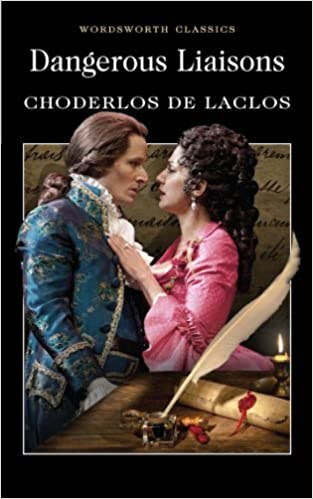
Dangerous Liaisons - Pierre-Ambrois-Francois Choderlos de Laclos (1782)


Dangerous Liaisons

The focus on the book list is shifting towards France and with Choderlos de Laclos’ “Dangerous Liaisons we are most unusually not in Rousseau territory and that in itself is a blessing.

This is the period just before the French Revolution, that period so famous for painted effeminate men with silly wigs and women in monstrous outfits, both with too much time on their hands and so little useful activity to spend it on. In France particularly so. “Dangerous Liaisons” is well and proper lodged in this environment.

The Vicomte de Valmont and the Marquise de Merteuil live and breathe for the games they play with other people. Their plots are to seduce their marks into scandal and ruin as if getting some sadistic pleasure from destroying people in the public eye while getting as much pleasure themselves in the process. In fact, I never really got the motivations straight. Is it malice or the glee of watching the morally self-righteous exposed as hypocrites? Or a selfish hunt for pleasure? The author is never entirely clear on this, which makes it tempting to think they are simply what “ordinary” people fear from rakes and libertines without caring too much at understanding their actual motivations. In this way they become more like boogeymen than real people

Anyway, the Vicomte and the Marquise keep up a correspondence discussing and cooperating on their various conquests. Valmont has his eyes set on a prudish woman, Madame de Tourvel whose husband is away on business while Merteuil wants to turn a 16 year old girl just out of school into her pupil. Cecile de Volanges is a naïve girl who is engaged to an older officer held up by an engagement on Corsica and Meteuil wants to use a young nobleman, Danceny, and later Valmont himself, to corrupt her.

This was clearly written as an exposé of the depravity of the idle nobility and struggles with a balance between enjoying the schemes and plots and juiciness of the affairs, and on the other side the moral codes that strongly disprove of all these sexual adventures. It is almost as if Laclos does not himself know if he approves or condemn Valmont and Mertuil. He lets them be successful in their corruption, deliciously so, but he also punishes them for their flawed characters. They are both smooth and clever, but also strangely delusioned, as if they only see the reality they want to see. Valmont is charming with the girls, but in his own head he is superhuman and in his interpretation of his exchanges with other people he only picks up the details that support this self-image.

Probably telling for the sympathies of the author it is not the impotent and useless morally upright that defeat Valmont and Merteuil, but their own weapons they turn on each other in an implosion of self-destruction. The women in particular are gullible and easy marks.

I was not blown away by “Dangerous Liaisons”. To be that, I think you need to feel the naughtiness of observing these shenanigans. The schizophrenic elements felt disturbing as if Laclos held back or could not make up his own mind and the epistolary form means a lot of repetition, not necessarily because the same events are described from several angles, but because the form itself includes all those tiring forms and protestations, making large chunks of each letter empty chatter. I did not feel this was scandalous in the way it was intended, but rather scandalous in the description of the idleness of these people. Whether they are men with nothing else to do than seducing women or women with nothing else to do than being bored.

It also feeds into a sexual moral that allows a lot more freedom for men than for women. It recognizes some of this unfairness in the dialogues, but seems in the final judgement to accept a much higher prize for women than for men for digressing from the morally acceptable path.

It was an okay book, but not recommendation from me.


tirsdag den 16. februar 2021

Reveries of the Solitary Walker - Jean-Jacques Rousseau (1782)


Reveries of the Solitary Walker

I have to say I am starting to get fed up with Rousseau.

The “Reveries of the Solitary Walker” is the third book from Jean-Jacques Rousseau on the List and, I get it, he was an influential personality during the Enlightenment, but you can only take so much complaining from a dude.

From the onset of doing this List I have been a bit confused what exactly made books qualify for the List. Does it have to be a novel or fiction? Why have important early works been omitted? Religious texts, fables, legends, science etc. To me it seems a bit random what qualifies and what does not yet in the case of Rousseau apparently anything goes. “Julie” was a novel, “Emile” was a philosophical work, “Reveries of the Solitary Walker” is a… not really certain… a defense? Or just plain complaining? And later on there will be a fourth that looks to me like an autobiography. There are many versions of the List, but they all seem to include all four books. Somebody must think this dude is really important.

As I understand it, Rousseau wrote “Reveries of the Solitary Walker” to defend himself against his persecutors. He is quite convinced that there are enemies around every corner and their entire purpose is to make his life miserable. Considering most of this book is devoted to these persecutors it is remarkable that we never learn why they are out to get him, what it is they claim Rousseau has done to them or even what it is exactly they do, except that they are everywhere.

Hmmm… I think that is called paranoia.

Rousseau’s escape from all this persecution is to dream away, to get absorbed in his own thoughts, whether these are thoughts on botany, past joys, children or fundamental concepts such as being a good person or happiness. When Rousseau does get absorbed in these thoughts it is almost pleasant to read, but it never lasts long. Eventually complaints sneak in and take over and we are back to all the people hell bent on ruining his life.

Still Rousseau insists that he has found his escape and that they cannot touch him now. In fact, the more they try, the less he cares. Except he does care, because this is what all this book is about. Like a little boy repeating, I am not afraid, I am not afraid, I am not afraid, which of course means he is very much afraid.

There was precious little to take away from all this ranting. I did enjoy his arguing why botany is the only natural science worth pursuing when you are a lonely old man, mostly because of the amusing images he paints of why it will not do for him to roam mines and chemistry labs or chasing animal to cut them up.

The rest was just pages I had to get through.

There must be better books to add to this list.


fredag den 5. februar 2021

Evelina - Fanny Burney (1778)


Evelina

Before Jane Austen there was Frances (or Fanny) Burney. Yet, where Austen is today a household name with a Hollywood installment every few years, Burney is an entirely new name to me, and that is a damn shame. Fanny Burney is awesome.

“Evelina” was Burney’s breakthrough novel, published when Burney was just 26 years old. It was an instant hit, and I can see why.

Evelina Anville (Belmont) is a 17 year old girl venturing out in the world for the first time. She has lived in seclusion in the country with her guardian and teacher her entire life, her mother, kicked aside by Evelina’s rake of a father, died giving birth to Evelina. So, Evelina is like an alien encountering all the modes and manners of society for the first time and since her parents were highborn, the world she encounters, is that of the upper tier.

In book one Evelina travels to London with her friends, the Mirvans, and see London for the first time. She is very insecure and uncertain how to act, but also acutely sharp in discerning the hypocrisy and mannerism of the upper class. During this visit, Evelina is approached her maternal grandmother, Mme Duval, who has come from France to take possession of her. Mme Duval is lowborn, but married into nobility and combines the lowborn crudeness with highborn mannerisms. Her relatives in London are the Branghtons, of a lower mercantile stratum. Having to navigate both gives Evelina opportunity to compare and she feels equally uncomfortable in either environment.

Where Evelina stayed with the upper echelon and from here encountered the lower class in the first book, in the second book it is the other way round. Forced to spend a month with Mme Duval in London she gets to be a lot with the Branghtons and in their company meet the upper-class characters from the first book.

In the third book, Evelina spends some weeks at the Hotwells near Bristol together with a group of members of the upper class. Again, Evelina is a fish out of water as she bemused try to stay afloat among the entitled and arrogant nobility.

Evelina herself is almost a non-character. We never learn that much about her. Focus is instead on all those characters she encounters, and what a galley of originals! The tone with which she describes these people is supposed to make us think that she does not approve of their behavior, whether it is foppish, crude, cheap or mannered, but it is very clear that Burney revels in her characters. The crude pranks of the sea-captain Mirvan on the pretentious Mme Duval or the foppish Mr. Lovel are described as atrocious, but Burney wants us to laugh. Burney is also full of satirical whit in describing the penny-pinching crudeness of the Branghtons, the indolent wastefulness of Lord Merton and the rakish falseness of Sir Willoughby, but the satire is not Evelina’s, she just communicates it, which is a very elegant move.

There are also some love stories and some mixed identity themes, as was common in this era, but those are far less interesting than the portrait of the very colorful society Evelina must navigate.

Among the many brilliant elements of this novel is Burney’s masterful language. Reading the book, I found the text surprisingly modern compared the contemporary books I have been reading lately. A large part of that is that much of the English written language as we know it to day was introduced by Fanny Burney in this book, when she was just 26 years old. Expressions, new words, syntax, you name it. Her contributions to the English written language is massive.

Add to that the spectacle she paints. Never before, to me at least, has the eighteenth century been this vivid. I could find her locations on maps from that time. The characters may be invented, but they feel very real despite the satire. You get the feeling Fanny Burney have actually visited these places and met people like this and thereby written a most realistic image of her world.

Even the love story and the mixed identity themes, full of unlikely coincidences, is a witty satire of the romantic ideal of the traditional novels. Tongue in cheek, it takes these elements just so far as they can carry.

Needless to say, I loved “Evelina” and can only recommend it. Fortunately, this is not the only Fanny Burney book on the list.


fredag den 8. januar 2021

The Sorrows of Young Werther - Johann Wolfgang von Goethe (1774)


The Sorrows of Young Werther

Johann Wolfgang von Goethe was one of the big authors. I Germany they are very proud of him and visiting you will get bombarded with adds from Goethe schools to learn German. My own experience with Goethe is however very limited and I mostly know of him from Faust, his famous play.

Back in the day, though, what really made Goethe famous was “The Sorrows of Young Werther” (“Die Leiden des jungen Werthers”). This was all the rage back in the late 18th century and I found it hilarious to learn that there was even a smart Chinese printer who made a version for export in Europe. Why does that sound so familiar today?

“The Sorrows of Young Werther” is a fairly short novel in the sentimental style that was so popular at the time and of which I already had a few examples. Only, Goethe goes all-out. His protagonist, Werther, is hyper emotional and sensitive to a degree that makes Rousseau look drab. In a modern context he would probably be diagnosed as bi-polar, but in the 18th century this sensitivity is merely fashionable. Werther gets moved by the simplest things in nature and gets a kick out of just watching people, but he is also easily agitated and provoked into a frenzy. We meet him as he arrives in Wahlheim where he soon meets and gets enchanted by Lotte. Only, Lotte is already engaged to Albert, a very decent and agreeable young man whom Werther also befriends. Soon Werther is in an odd triangle, being madly in love with Lotte while having an amiable friendship with Albert.

Eventually, Werther leaves the couple when this is getting too weird. He embarks on a diplomatic career but keeps clashing with his employers. It is clear that Werther considers himself smarter than all these men, but he is also out of touch with decorum and his career flounders. In disappointment he returns to Wahlheim and continue the triangle, but with a melancholic and depressive slant. He is like a moth to the flame and it is devouring him until in the end he kills himself.

The interesting thing here and the brilliance of Goethe is that we see all this with the eyes of Werther. Goethe sets up an epistolary novel, what today would be called “found footage”, consisting of letters Werther writes to his friend Vilhelm. That means we are supposed to read Werther’s own account of the affair. Sometimes he is completely biased as an unreliable witness, projecting his emotions on what he observes, sometimes he more objective, trying to be rational, to the extent of rationalizing his own actions. His emotional rush are the colors used to describe the scenes and Werther is always in an emotional state. The epistolary novel is at this time not new, but Goethe uses it very successfully to paint this character by letting us witness his writings. That the character itself is insufferable is another thing, but there is no question that Goethe manages to bring him to life.

Part of the legend is that the novel is partial autobiographical, Goethe was himself involved in such a triangle, and many readers saw this as an endorsement of the hypersensitive lover and made an ideal out of this desperate infatuation. I think this impression is merely a result of Goethe’s skill, that Werther becomes so real to the reader, a bit like Orson Welles “War of the Worlds” radio show, that they buy into the character and the romance. I think Goethe was a lot more critical to Werther, I think he painted him a bi-polar, as a sociopath who is unable to cope with life, more like a warning than an example. But because Werther is so real he was misunderstood.

This was maybe not my kind of book, triangle dramas are not my thing, but Goethe’s talent is unquestionable, and I look forward to his other entries on the List.


torsdag den 31. december 2020

Happy New Year 2021


Happy New Year 2021!

To say 2020 was the worst year ever is historical ignorance, but I cannot personally remember a year that felt as crap the one that is now ending. I am certain I do not need to expand on the reasons why, that must be obvious to anyone alive on planet Earth.

As we are about to start a new year, we are going through a second lockdown in Denmark. We may have done decently early on, but now it is going pretty bad and the only consolation is that we have finally started on the vaccination program. Let us just say we are starting the year on a low.

Thankfully, here at home we are okay and so is my closest family so there is that. There has been Corona positives in the larger family, but nobody got very sick (fingers crossed).

On my movie blog it was par for the course. I reviewed 59 movies in 2020. Of these 49 were List movies and 10 were off-List movies. Clearly, going off-List is getting a life of its own and I have to consider if I need to change the format on that, but that will be for another time. The 49 List movies took me from 1969 to 1972. Not a long period at all, 1971 was a killer year with the largest number of movies yet for a single year. It was as usual a mixed bag of candy, but enough great movies and small surprises to keep it interesting.

What really took off in 2020 was my book blog. Not that anybody actually reads it, but I was far more active there than I have been in previous years. The count ended on 14 books, which is almost 3 times more than my target. Lockdown provides for a lot of time to read. This took me from Tom Jones (1749) to Humphry Clinker (1771), about 22 year, mostly covering a golden period in British literature in the mid-eighteenth century. The quality was more varied that I am used to with Rousseau and Sterne marking low points, but also with great stuff from Smollett, Fielding and Lennox. I may not be able to keep up this pace for long, but it is a consolation during lockdown.

I wish all my readers a happy New Year, hope sincerely that you will stay safe and that there is good stuff out there on the other side.

lørdag den 26. december 2020

The Expedition of Humphry Clinker - Tobias Smollett (1771)


The Expedition of Humphrey Clinker

“The Expedition of Humphry Clinker” is the second book by Tobias Smollett on the List and, oh boy, is this a step up, both from his first entry and from the mediocre stuff I have been reading lately.

Tobias Smollett was a man of comedy and satire, but what he did with “The Expedition of Humphry Clinker” was to tone down the sarcasm and wittiness and instead embrace a concept to the extent that it truly comes alive. We follow a group of people as they travel around Britain, consisting of the bachelor squire Matthew Bramble, his sister, aging spinster Tabitha, his niece and nephew, Liddy and Jerry and an assortment of servants, particularly Tabitha’s maid Winifred Jenkins. The story is their journey and experiences, both with each other and with the places they pass through. As an interesting and elegant stylistic touch, the story is written as letters these people are sending back to people they left at home. In this way we get different viewpoints, often on the same events, as first (and sometimes second) hand accounts as these people are experiencing them.

Mr. Bramble is an excitable and hypochondriac patriarch with a good heart but very opinionated. Likely a cover for the author himself. His viewpoints are rather settled, there are those things he despise, dirt, stink, hypocritic coxcombs and insensible management, and there are those he love, which are decent, honest people, cleanliness and common sense. His letters are often counterpointed by Jeremy’s letters. His young age allows for a more unprejudiced viewpoint, especially where Mr. Bramble gets agitated, and he is the progressive one pointing out absurdities both in his travelling party and in the environment, they are travelling through.

Tabhita is described comically is a nightmare of a woman, past her prime and desperately looking for a husband, she jumps at everything male until refused, at which point she despise them with a vengeance. She is petty and cheap and very impressed with herself and therefore an easy mark for hilarity. Liddy is almost the opposite, a timid young girl who offers a romantic element to the story as she is wooed by the mysterious Mr. Wilson. Finally, Winifred offers the servant point of view in letters of poor spelling, misunderstandings but also common sense.

The story follows two tracks, one of character development and the second of a travelogue through 18th century Britain. The character development side to the story holds some elements of romance and mistaken identity, both favorites of the era,  but it is in the interaction of these characters that we see the real progression of the characters. Mr. Bramble learning to appreciate the active life, Jerry to control his temper and Tabitha finds her match from the most unlikely corner. This is all fun and interesting, but the satire never crosses the line and become unbelievable. As original as these characters are, they remain absolutely believable and even today they are recognizable.

Yet, in my opinion the travelogue is the greatest asset of the novel. I am not one for long descriptive parts, but this portrait of 18th century England and Scotland, as seen from different angles is fascinating stuff. The spa life in Bath, high society hypocrisy in London, a seaside escape on the Yorkshire coast, the curious habits of the Scotch such as eating haggis, drinking Whiskey and playing that weird game they call golf… To sit here in the 21st century and read an excited description of these well known institutions, written with a wonder and curiosity of a novel experience is infectious. I could not get enough of it.

What impressed be much was how Smollett went from his rambling and inconsistent style of “Peregrine Pickle” to this super tight and consistent masterpiece and without losing the astute and humorous perception. I am so used to these “almost-right” novels of the 18th century that I am frankly surprised at finding one so well-rounded and polished. There is never too much, the editing is sharp, but still, it has room for a wealth of detail. He is also able to go through with his concept down to the details. Each character writes, and writes consistently, in his particular style with consistent wordings, mistakes and penchants. You believe Smollett actually visited the places or met people like those he describes. There is no sloppiness here.

I thoroughly liked “The Expedition of Humphry Clinker”, one of the best books so far on the list, and this is certainly a recommendation from me.

And Humphry Clinker? He is just some dude the party picks up on the way.


lørdag den 28. november 2020

The Man of Feeling - Henry Mackenzie (1771)


The Man of Feeling

In my last review, on “A Sentimental Journey Through France and Italy”, I introduced to theme of the sentimental novel. Well, we are there again, this time condensed to the exclusion of anything else.

“The Man of Feeling” has a single purpose, to present several tableaux to move the reader. We are supposed to cry a little, feel sorry for the unfortunate, a bit of weltsmertz and then on to the next. Apparently back in its day this really worked. Henry Mackenzie’s “The Man of Feeling” was an instant bestseller and remained so for a long time. The individual tableaux were singled out and used whenever people needed to be moved and in the world of sentimental literature Mackenzie was legend.

Here is the thing though: There is literally nothing else in this novel. No progressive narrative, no character study, no morale, except that for many people life stinks. Therefore, all depends on that these small bits of emotional porn work their magic.

Structurally, this is a story within a story within a story. The outermost shell of this literary babushka doll is Mackenzie himself. He is writing about some curate who accidentally come by a fragmented text. The text is written by an observer (likely a fellow called Sedley) who is telling the story of a gentleman called Harley. The fragmentation of this manuscript allows the author to skip in the narrative so what we get are a number of incidents were Harley is the observer to somebody else’s story. Harley rarely interacts with the unfortunate any further than listening to them and offer a bit of assistance or sympathy. He is the sentimental person who is moved by the story and obviously it is hoped that this translates to the reader.

There are stories about fallen women, old people sent to the army, a father to a prostitute, the mental ill and so on. These stories are naturally sad stories, and as such they are milked to the max. The major problem, at least my issue with them, is that they are tableaux. We are presented to people who then disappear, we have no deeper relationship to them and therefore I do not feel as much impact from their stories as I would had I known them better. The characters easily become non-entities or types rather than actual people and that significantly reduces the emotional impact. For this reason, “The Man of Feeling” does not carry anywhere close to the impact today as it apparently did back then.

This is a real problem, when the only leg the book has to stand on turns out to be weak and this is why I am rather indifferent to the book. It is a lot easier to read than Sterne, but as a sentimental novel I much preferred “A Sentimental Journey Through France and Italy” as we here at least had a focus in Yorick and the book became a character study on him. I know practically nothing of Harley except he was a passive and easily moved fellow.

The value of “The Man of Feeling” is mostly its significance in the development of the sentimental and romantic genre. In itself I found it less than impressive and I do not think there is much to recommend it.